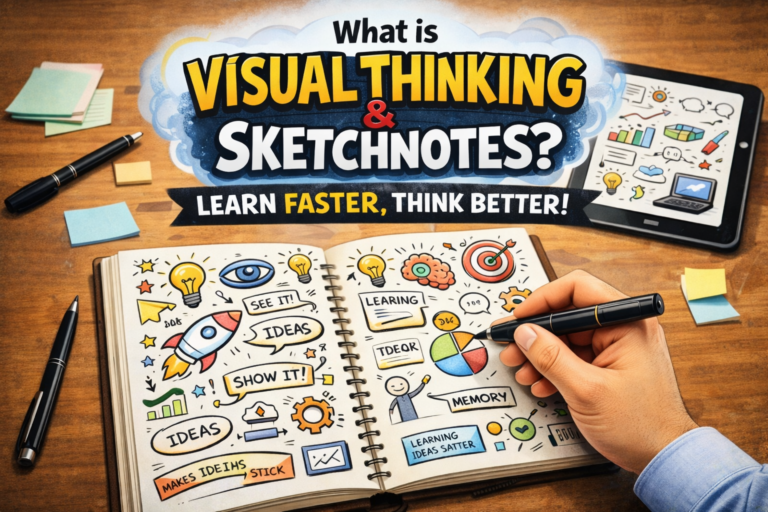

Make Learning Fun and Powerful with Visual Thinking Sketchnotes
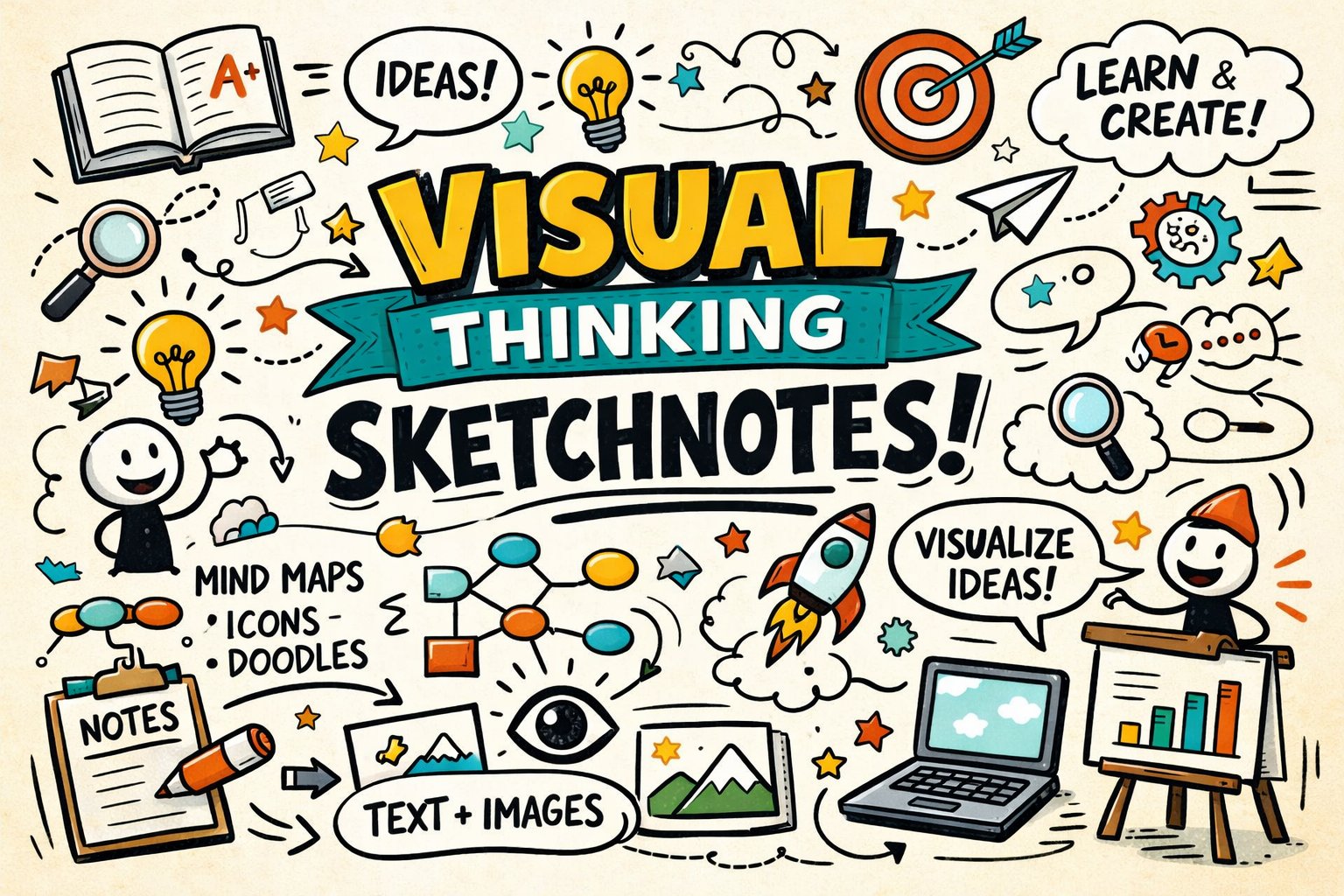
Have you ever written three pages of notes… and remembered almost nothing? Now imagine transforming those dense lecture notes into colorful doodles that stick in your brain like a catchy song. That’s the magic of visual thinking sketchnotes – a game-changing way to make learning fun, memorable, and creative.
Instead of endless bullet points, you blend words, icons, and sketches to capture ideas visually. Popularized by Mike Rohde, sketchnoting turns passive note-taking into an active, joyful process that boosts retention by up to 65% (per studies from the University of Waterloo).
Visual Thinking Sketchnotes are powerful for:
- 🎓 Students taking lecture notes
- 🏫 Teachers explaining concepts
- 💼 Professionals in meetings
- 🚀 Entrepreneurs planning ideas
- 🎨 Designers mapping strategy
- 📊 Researchers summarizing findings
Sketchnotes help complex information become clear, structured, and easier to remember.
Why Visual Thinking Supercharges Learning
Our brains love pictures. Neuroscientists say we process visuals 60,000 times faster than text, thanks to the dual-coding theory – pairing words with images creates stronger neural connections. Sketchnotes tap this by mimicking how we naturally think: messy, interconnected, and colorful.
- Boosts memory: Doodles anchor facts emotionally.
- Sparks creativity: No perfection needed – just play.
- Reduces boredom: Turns “blah” lectures into art adventures.
- Improves focus: Your hand stays busy, mind stays sharp.

You Don’t Need to Be an Artist
One of the biggest myths about sketchnoting is that you need to be good at drawing. You don’t. Sketchnotes are not about artistic perfection; they are about clarity. Simple shapes such as circles, squares, stick figures, and lines are more than enough. The goal is to capture meaning, not create a masterpiece. Over time, your visual vocabulary naturally expands, and your confidence grows.
Sketchnotes combine:
- Keywords instead of long sentences
- Simple drawings and icons
- Arrows and connectors to show relationships
- Typography and visual hierarchy
- Intentional layout and spacing
More importantly, sketchnoting forces active, deep processing. To draw a concept, you must first truly understand it. You cannot sketch what you haven’t grasped. This pushes you out of passive, copy-paste thinking and into the kind of engaged comprehension that builds lasting knowledge.
✍️ How to Start (Even If You Can’t Draw)
You only need:
- Blank Notebooks & Paper
- A black pen
- An open mind
Start with these basics:
- Write only keywords
- Draw simple icons (light bulb = idea, arrow = flow)
- Use boxes and banners for titles
- Add arrows to connect ideas
- Leave white space
That’s it.
Progress over perfection.
For teachers and facilitators, visual thinking becomes a powerful engagement tool. Explaining complex topics through diagrams, flowcharts, and illustrated frameworks keeps learners attentive and involved. Strategists and business leaders can use sketchnotes to map ideas, clarify problems, and communicate plans effectively. Professionals attending conferences or webinars can quickly summarize insights in a way that is easier to revisit and share.
More Than Notes – A Thinking Skill
Sketchnoting is not just about taking better notes. It’s about thinking better.
It trains you to:
- Distill complexity into clarity
- Recognize patterns and relationships
- Communicate ideas visually
- Engage your brain actively
- Learn with curiosity and creativity
When you start seeing ideas instead of just writing them, learning changes. Information becomes meaningful. Concepts become connected. And your notes become something you actually want to revisit.
Visual thinking turns learning into an experience
Over time, your visual vocabulary naturally expands. The more you practice, the more confident you become.