
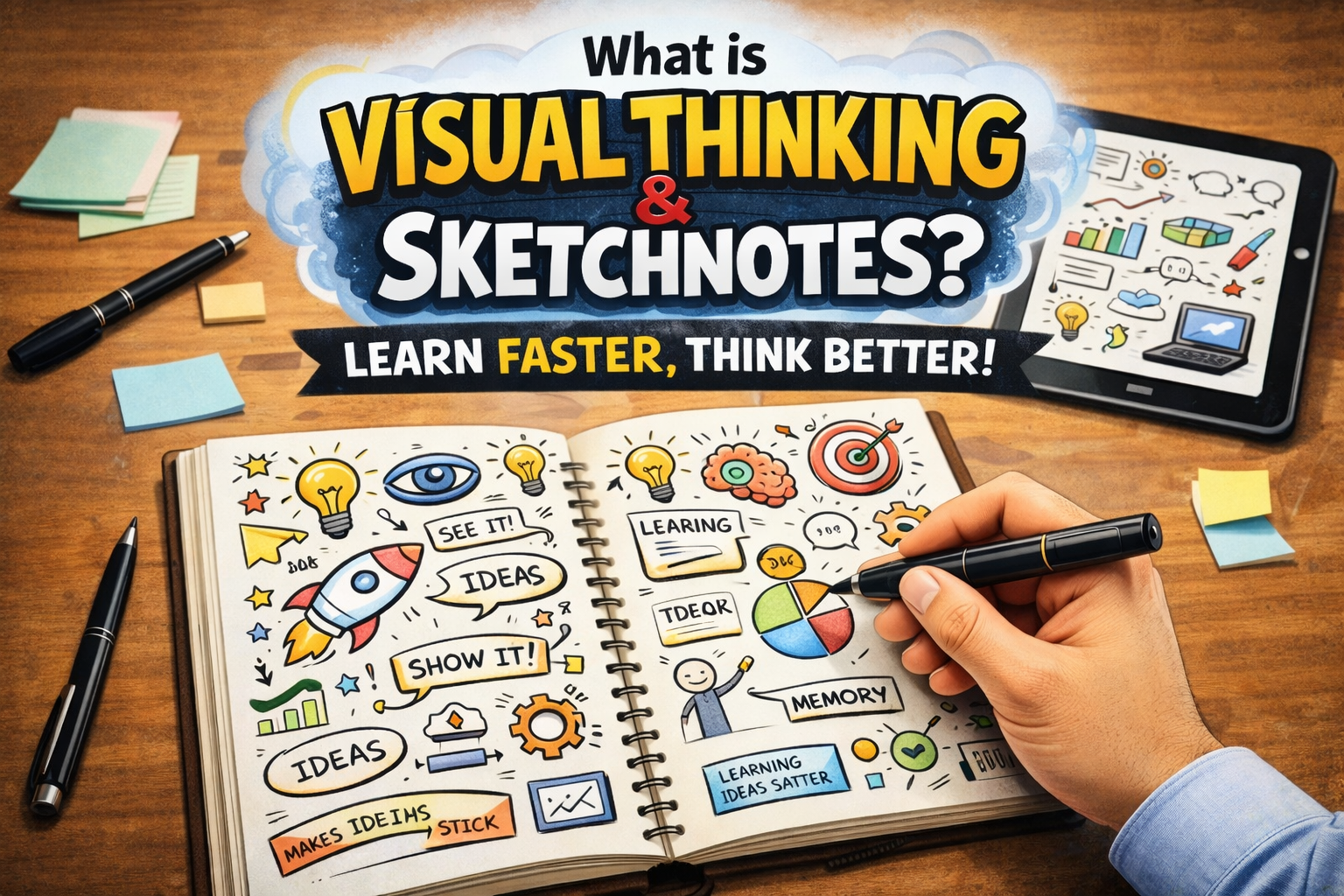
What is Visual Thinking and Sketchnotes? Learn Faster, Think Better
Why Your Brain Thinks in Pictures
Close your eyes and think of the word “apple.” What did you see? A word or an image?
For most people, it was an image. That’s because the human brain is wired to process visuals up to 60,000 times faster than text. Yet most of us spend our days buried in walls of words – in emails, documents, textbooks, and slides.
Visual thinking and sketchnotes offer a powerful antidote. They bridge the gap between how we naturally think (in images, patterns, and connections) and how we traditionally communicate (in text). Whether you’re a student trying to retain lecture notes, a professional mapping out strategy, or a creative thinker looking for clarity – visual thinking will transform the way you learn and work.
In today’s fast-paced digital world, where information is overwhelming and attention spans are shrinking, the ability to learn faster, think clearly, and remember effectively has become a powerful competitive advantage. This is where visual thinking and sketchnotes emerge as a smart and transformative solution. Visual thinking is the process of using images, symbols, diagrams, and visual structures to understand and communicate ideas more effectively, while sketchnotes are a powerful visual note-taking technique that combines words, icons, arrows, and layouts to capture information in a clear, engaging, and memorable way. Instead of relying on long, text-heavy notes, visual thinking allows the brain to process ideas faster, connect concepts easily, and retain knowledge for a longer time.
What Is Visual Thinking?
Visual thinking is a cognitive process that involves interpreting information through visuals such as diagrams, sketches, symbols, and spatial organization. The human brain is naturally wired to process visual information significantly faster than plain text, which makes visual learning more effective and engaging. According to visual perception theorist Rudolf Arnheim, thinking is not only verbal but deeply visual, meaning that images and visual relationships play a crucial role in understanding complex information. When learners convert abstract ideas into visual formats, they reduce cognitive overload and improve comprehension, focus, and long-term memory retention.
Visual thinking is not about being a skilled artist. It’s about using a visual language — a shared vocabulary of simple shapes, icons, arrows, and layouts — to make complex ideas tangible and accessible.
At its core, visual thinking asks: What does this idea look like?
Visual thinking is used across disciplines — from design and engineering to education, therapy, business strategy, and journalism.
What Are Sketchnotes? A Powerful Visual Note-Taking Method
Sketchnotes are the practical application of visual thinking in note-taking and idea capture. Popularized by visual thinking expert Mike Rohde, sketchnoting focuses on capturing key ideas instead of writing everything word for word. This powerful method uses simple drawings, containers, arrows, typography, and icons to represent information visually. Sketchnotes transform passive note-taking into an active and creative learning process, helping individuals engage deeply with the content and understand concepts more clearly.
The Science Behind Visual Learning
Why do visuals work so well? The answer lies in cognitive science.
Dual Coding Theory
Psychologist Allan Paivio’s Dual Coding Theory (1971) proposes that the brain processes verbal and visual information through two separate but interconnected channels. When you encode information both verbally (through words) and visually (through images), you create two mental “hooks” for the same idea — making retrieval far more reliable.
Sketchnotes naturally exploit dual coding. When you draw an icon of a lightbulb next to the word “innovation,” you’re encoding that concept twice — once as text, once as image.
The Picture Superiority Effect
Research consistently shows that people remember images far better than words. In one classic study, participants who saw pictures had recall rates of over 65% after three days, compared to roughly 10% for text alone. This phenomenon, known as the Picture Superiority Effect, explains why visual notes stick.
Cognitive Load Theory
John Sweller’s Cognitive Load Theory argues that working memory has limited capacity. Well-designed visual representations reduce cognitive load by chunking information spatially and using visual hierarchy — freeing up mental bandwidth for deeper understanding rather than just tracking sequence.
Active Processing
Sketchnoting forces active engagement. You can’t passively copy a sketchnote the way you can transcribe text. You must listen, synthesize, prioritize, and then render – engaging higher-order thinking skills throughout.
Benefits of Visual Thinking and Sketchnotes
Improved Retention and Recall
By combining images and words, sketchnotes help you remember significantly more than traditional notes. Studies suggest visual learners retain up to 65% more information when it’s presented visually.
Deeper Understanding
Translating ideas into visual form requires comprehension first. You can’t draw a concept you don’t understand. This process forces clarity and weeds out surface-level memorization.
Increased Engagement
Sketchnoting is genuinely enjoyable. The act of drawing keeps your brain alert and engaged during meetings, lectures, or reading sessions where attention might otherwise drift.
Better Organization of Complex Ideas
Visual thinking allows you to see relationships between ideas that are invisible in linear text — hierarchies, cycles, flows, contradictions, and clusters — all at a glance.
Stronger Creative Thinking
Shifting to a visual mode of thinking opens up lateral and associative thinking. Many breakthroughs in design, science, and business have started with a sketch.
Clearer Communication
Sharing a sketchnote communicates far more quickly and accessibly than a dense memo. Visual communication is intuitive and crosses language barriers.
Personal Satisfaction
There is a unique satisfaction in creating something with your hands that is both useful and visually expressive. Sketchnotes reconnect many people with the joy of drawing they may have lost in adulthood.
Core Elements of a Sketchnote
Every sketchnote is built from a small set of fundamental elements. Mastering these gives you an infinite toolkit.
Typography and Hand Lettering
Text in a sketchnote isn’t just text — it’s expressive. Key ideas can be written in bold block letters, italicized, underlined, outlined, or given shadow. Varying your lettering creates visual hierarchy and draws the eye to what matters most.
Icons and Symbols
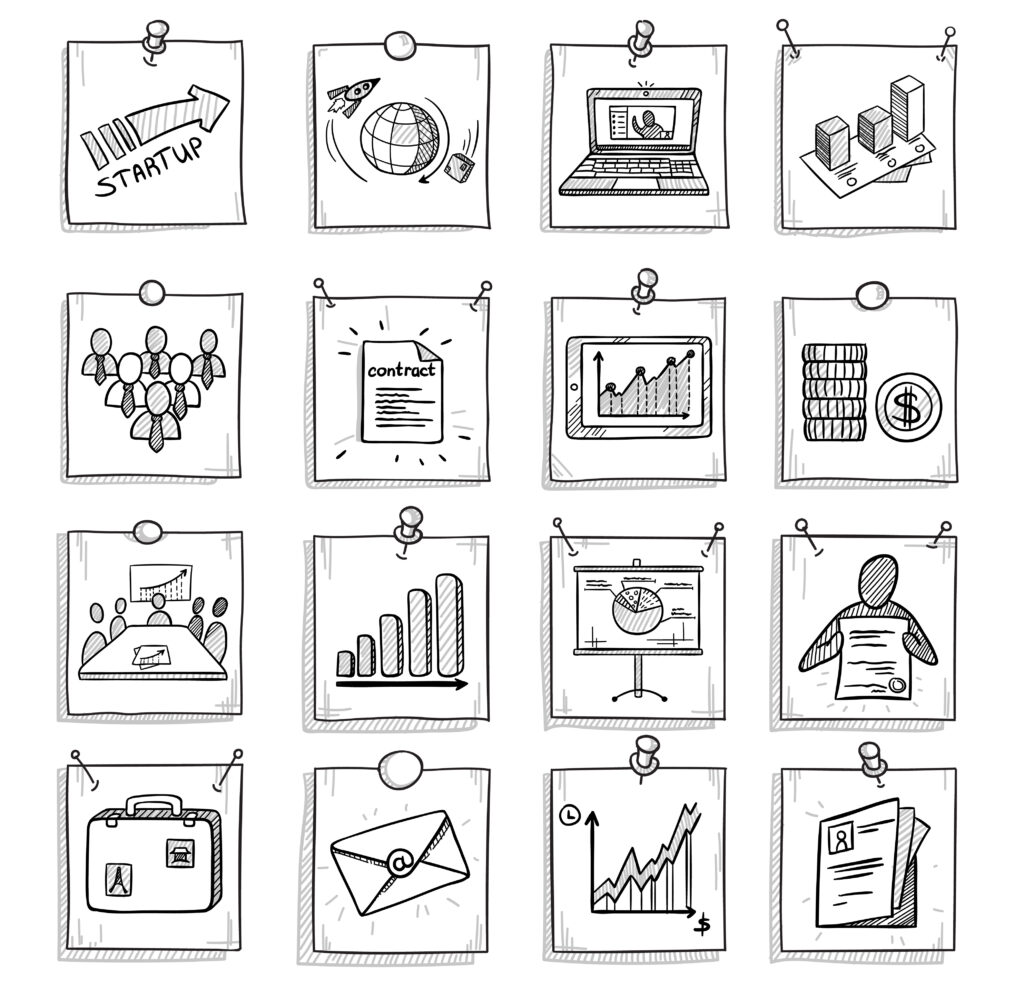
Simple, consistent icons form the backbone of a visual vocabulary. A lightbulb for ideas, a speech bubble for dialogue, a star for highlights, an arrow for direction. You don’t need to invent these — you build a library of repeatable, simple drawings over time.
Containers and Dividers
Boxes, banners, circles, speech bubbles, and clouds are used to group related ideas and give the page visual structure. A banner heading signals importance. A dashed line marks a new section.
Connectors and Arrows
Arrows, lines, and flow elements show relationships between ideas. A dotted line might indicate a weak connection. A bold arrow might show cause and effect. These connectors transform a collection of ideas into a connected map.
Color
Strategic use of color adds another layer of meaning and visual hierarchy. Even two or three colors used consistently can transform a sketchnote. One color for headings, another for supporting details, and a third for emphasis is a common and effective approach.
Faces and Figures
Simple faces and people — even stick figures — add warmth and relatability. A five-line face expressing surprise, joy, or confusion communicates emotion instantly.
Layouts
Sketchnotes come in different structural layouts: linear (top to bottom), radial (ideas branching from a center), modular (a grid of visual chunks), path (following a journey), or skyline (varying heights for different sections). Choosing the right layout depends on the content structure.
Practical Ways to Start Visual Thinking and Sketchnoting
Beginners can start practicing visual thinking and sketchnotes by focusing on key ideas instead of writing full sentences. Using simple shapes to represent concepts, organizing notes into visual sections, and connecting ideas with arrows and icons can significantly improve understanding and retention. Over time, this practice builds a personal visual language that enhances learning speed, creativity, and cognitive clarity. Whether done on paper, tablets, or digital tools, the core principle remains the same: visualize ideas to understand them better and remember them longer.